

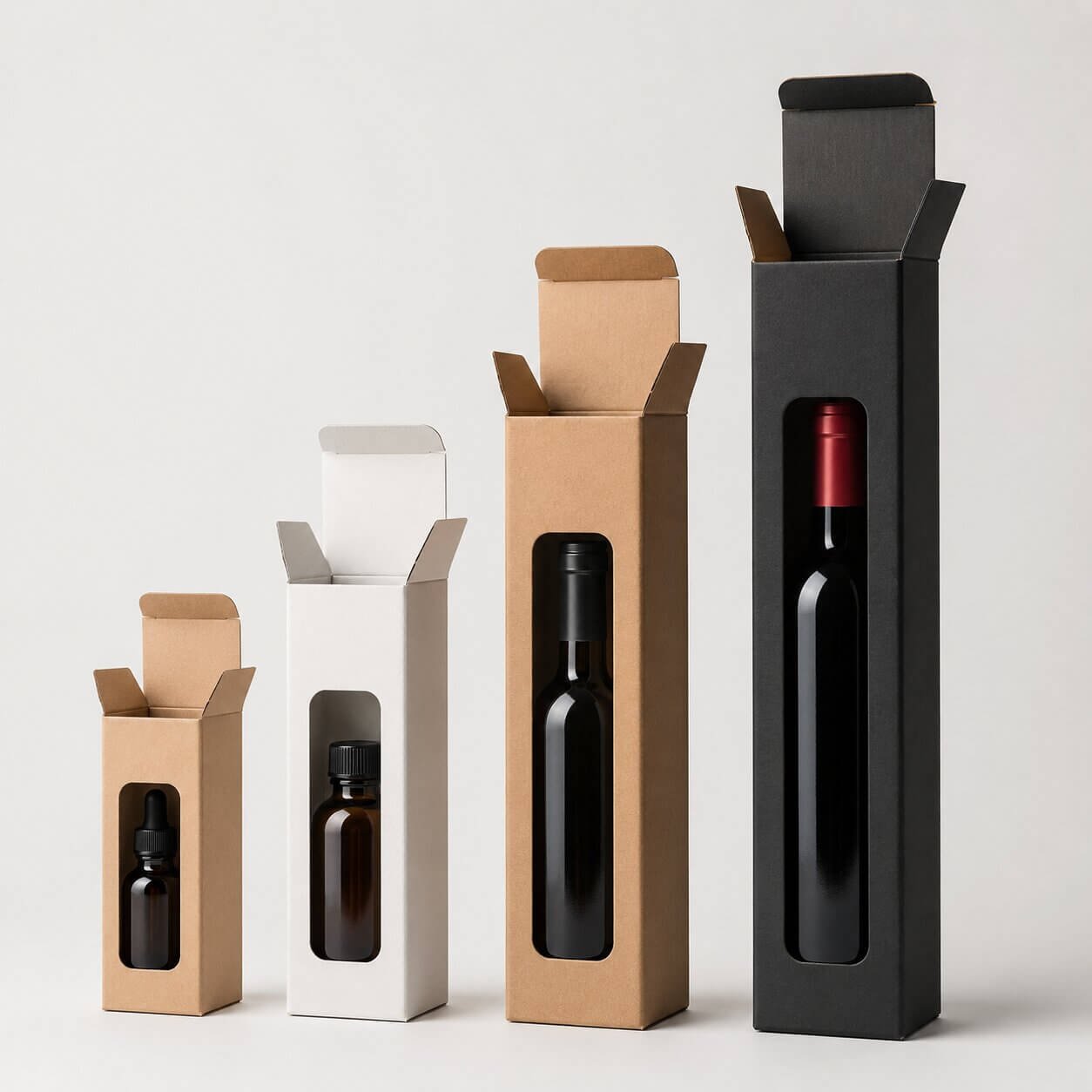
Selecting the right Custom Bottle Box Sizes is one of the most overlooked aspects of packaging a liquid product — and the most costly. A box that’s too loose lets bottles rattle and break in transit, while a box that’s too tight can make unpacking difficult and damage caps or droppers. Whether you’re packing a 10ml essential oil bottle or a 500ml skincare bottle, choosing the right custom bottle box sizes will protect your product, reduce shipping costs, and strengthen your brand at the printed side of the box.
This guide explains how standard sizes are sized, what you can measure, and which boxes you can buy to ship to the UK in custom or stock boxes.
What Are the Standard Box Dimensions for 10ml to 500ml Liquid Bottles?
Size of bottle box differs based on bottle shape, cap style, and whether you use inserts. Below is a breakdown by bottle types.
10ml to 30ml Dropper Bottle Box Dimensions
Small dropper bottles used for serums, tinctures and essential oils usually need boxes from 30ml x 35mm x 100mm to 45mm x 45mm x 120mm. Droppers increase the bottle’s height so measure with the dropper inside, not just the bottle itself.
50ml to 60ml Essential Oil & Perfume Box Dimensions
This category is middle-sized and fits boxes from 45mm x 45mm x 130mm to 55mm x 55mm x 150mm. Perfume bottles with wider shoulders or caps require an additional 3–5mm of clearance on either side to avoid pressure marks on printed finishes.
2oz to 3oz Cosmetic & Liquid Bottle Box Dimensions
Cosmetic bottles of the size 2oz – 3oz (60ml – 90ml) need boxes with sizes from 50mm x 50mm x 140mm – 60mm x 60mm x 170mm. These boxes are ideally square or hexagonal and minimize the area on display and maximize the print area for branding.
500ml Large Bottle Box Dimensions & Heavy-Duty Packaging
Large-format bottles require either reinforced corrugated or thicker cardstock (90mm x 90mm x 220mm, 110mm x 110mm x 260mm). Heavy-duty flute board and locking base tabs are required to prevent the bottles from collapsing under load during storage in the warehouse or courier transportation.
How to Accurately Measure Bottle Dimensions for Custom Boxes (3-Step Formula)
Getting box dimensions right comes down to three consistent measurements.
Step 1: Measuring Total Height (Including Cap & Dropper)
Measure from the base of the bottle to the top of the cap, pump, or dropper – never the body of the bottle alone. This mistake is the leading cause of boxes that don’t close properly.
Step 2: Calculating Bottle Width, Diameter & Clearance
Measure the widest point on the bottle (usually the shoulder or label area) and add 2–4mm of clearance on each side. Too little clearance will make insertion difficult; too much will allow movement and increase breakage risk.
Step 3: Factoring in Custom Inserts & Protective Dividers
If you’re using foam inserts, cardboard dividers, or moulded pulp trays, add their thickness to your base dimensions. Inserts also affect the way your printed labels are viewed once the box is opened, so make sure your label design matches your box design when unboxing.
Custom Bottle Sizes vs. Standard Boxes: Which Is Better for UK Shipping?
Standard stock boxes are cheaper upfront and easier to source and they are perfect for testing new products or distributing low quantities. But, they rarely match the dimensions of your bottles exactly, resulting in wasted filler material and higher dimensions for shipping (a real factor in the prices of UK couriers such as Royal Mail and DPD).
Customised bottle boxes will be custom-designed to your exact bottle shape, cutting out all waste, reducing postage costs by not shipping as many boxes as possible and giving the brand full control over the print quality, the strength of the box itself, and the packaging when it arrives. For brands that often ship across the UK, custom sizing is likely to pay for itself within a few hundred boxes through reduced damage claims and reduced postage costs.
Key Takeaways & Sizing Checklist for Custom Bottle Packaging
Always measure the height of the bottle with the cap/dropper on, not the bottle itself Add 2–4mm clearance around the widest point of the bottle and account for the insert thickness before finalising box dimensions Use reinforced board for 500ml or larger bottles to avoid stacking damage Match the size of the box with the label for a consistent brand look Choose custom boxes over stock boxes where volume of shipping is high or the packaging is fragile. Larger batches of 10ml, 15ml, Custom E liquid Boxes and 30ml dropper bottles need to be sizing as even a few millimetres of extra clearance can cause movement in the box.
Getting Custom Bottle Box Sizes right can help you protect your product, cut shipping costs, and strengthen your brand from the packaging to the customer. Find out more about custom size estimates and the appropriate label styles at the printed packaging. Read more: book mailer