
Picking the right greeting card size is one of those things that seems simple until you actually start designing one. The size you choose affects the layout, the amount of space for your message, the envelope, printing costs, and sometimes even postage.
There are plenty of card sizes available, but most greeting cards fall into a few familiar formats. Once you know the common dimensions, it’s much easier to choose one that fits your design.
Here’s a look at the most popular greeting card sizes, envelope dimensions, folded and flat cards, and a few printing details worth knowing before you place an order.
What Is the Standard Greeting Card Size?
A 5 × 7 inch card is one of the most common greeting card sizes. It’s large enough for artwork and a decent-sized message without feeling bulky.
In millimetres, it measures roughly 127 × 178 mm.
Other sizes are also widely used:
| Card Size | Approx. Size in MM | Common Use |
| 4 × 6 inches | 102 × 152 mm | Small cards and short notes |
| 5 × 7 inches | 127 × 178 mm | Birthday and general greeting cards |
| 6 × 6 inches | 152 × 152 mm | Square designs |
| A6 | 105 × 148 mm | Compact greeting cards |
| A5 | 148 × 210 mm | Larger cards and folded designs |
If you’re unsure which one to use, 5 × 7 inches is a good starting point because it suits a wide range of card designs.
Why Does Greeting Card Size Matter?
Card dimensions affect more than just the appearance of the finished product.
A larger card gives you more room for photographs, illustrations, decorative elements, and longer messages. A smaller card keeps things compact and can work especially well for short handwritten notes.
The envelope is another important factor. Your card needs to fit comfortably inside without being forced in or leaving too much empty space.
Weight can matter too. If you’re sending a large number of cards, the combination of card size, paper thickness, and envelope can affect your mailing costs.
What Is the Best Size for a Birthday Card?
For a traditional birthday card, 5 × 7 inches is probably the easiest choice.
There’s enough room on the front for a large image, illustration, or greeting, while the inside gives you plenty of space for a personal message.
A 4 × 6 inch card is better suited to something smaller and simpler. If you want the design to stand out, a 6 × 6 inch square card is another option worth considering.
The important thing is to match the size to the design. A detailed illustration shouldn’t be squeezed into a tiny layout just because the card is cheaper to print.
What Size Are Christmas Cards Usually?
Christmas cards commonly use 5 × 7 inch or A6 formats.
A6 measures approximately 105 × 148 mm, so it’s a little more compact than a 5 × 7 inch card.
If you’re including a family photograph, several design elements, or a longer seasonal message, 5 × 7 inches gives you more breathing room.
For larger orders, remember to consider the envelope and postage as well as the card itself.
What Size Envelope Do You Need for a Greeting Card?
The envelope should be slightly larger than the finished folded card.
For example, if your folded greeting card measures 5 × 7 inches, you need an envelope that can comfortably hold that finished size.
Some common envelope sizes include:
| Envelope Size | Approx. Dimensions |
| A2 | 4.375 × 5.75 inches |
| A6 | 4.75 × 6.5 inches |
| A7 | 5.25 × 7.25 inches |
| A5 | 5.875 × 8.25 inches |
These measurements can vary between manufacturers, so check the supplier’s specifications before ordering.
If your card has thick cardstock, several layers, ribbons, or other embellishments, allow a little extra room.
What Are the Common Envelope Sizes for Greeting Cards?
The A7 envelope is a popular choice for 5 × 7 inch cards. Its slightly larger dimensions make it easier to insert and remove the card.
For smaller cards, A2 or A6 envelopes may be more suitable. A5 envelopes are useful when you’re working with larger card formats.
Don’t choose an envelope based on the paper size alone. Think about the actual finished card, including its thickness.
What Is the Best Size for a Thank-You Card?
Thank-you cards are often smaller because they usually contain a short message rather than a lot of content.
A 4 × 6 inch or A6 card is a practical choice for this purpose. It gives you enough space for a short note while keeping the card neat and easy to handle.
A 5 × 7 inch card works just as well if you want more room for artwork or a longer message.
For business thank-you cards, a simple layout with plenty of white space can work particularly well.
What Size Should a Note Card Be?
Note cards are generally smaller than standard greeting cards.
Popular options include:
- 4 × 6 inches
- A6
- 5 × 7 inches
A 4 × 6 inch card is useful when the message is short. If you need more writing space, moving up to A6 or 5 × 7 inches gives you a little more room.
The best size depends on how much you expect people to write on the card.
What Is the Difference Between a Flat and Folded Card?
The difference is pretty straightforward.
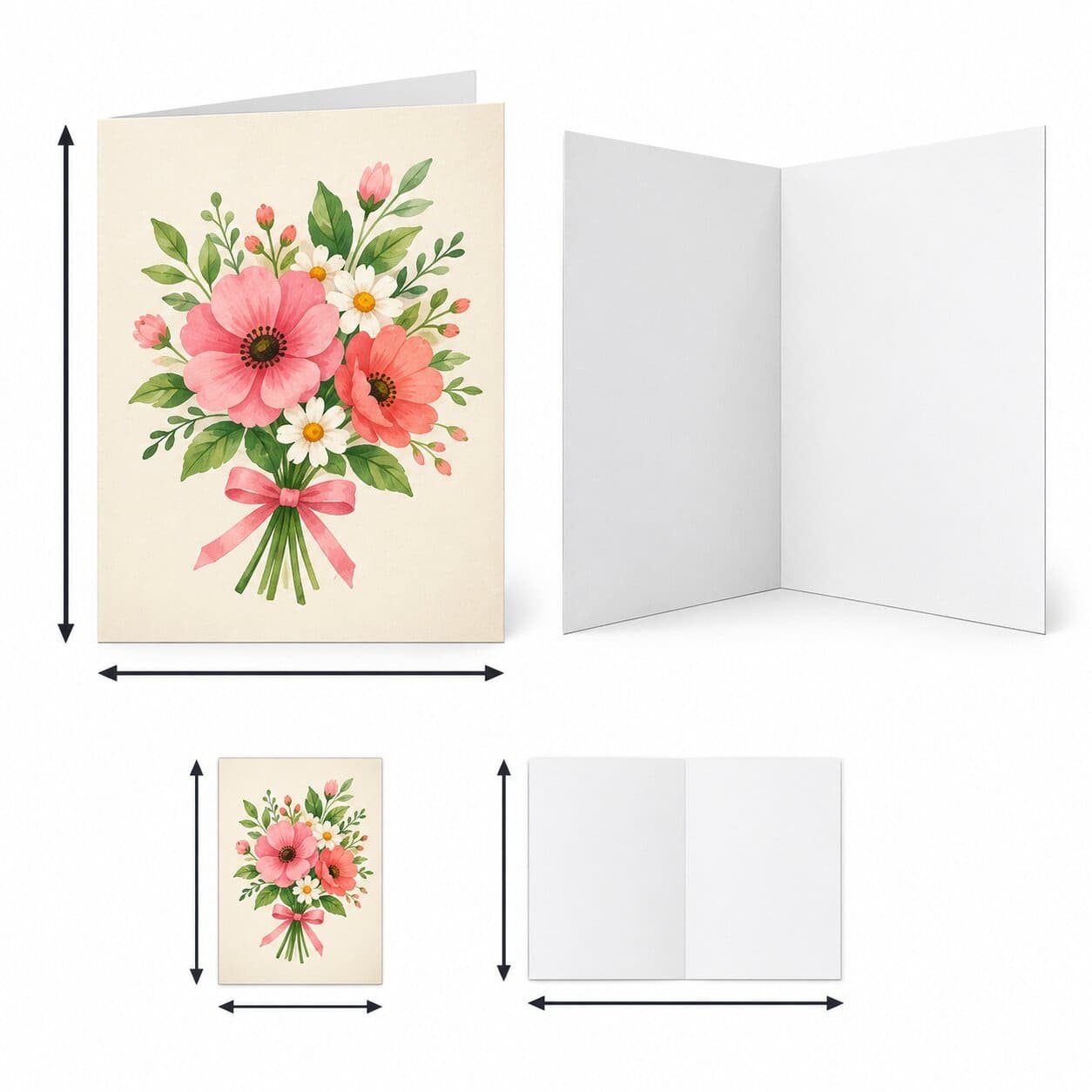
A flat card is a single piece of cardstock with no fold. A folded card has a crease, usually down the centre, creating a front, back, and inside area.
For example, a finished folded card measuring 5 × 7 inches generally starts with a flat sheet around 10 × 7 inches before it’s folded.
This is important when setting up your artwork. The file needs to account for the full sheet size, not just the finished front cover.
How Much Bleed Does a Greeting Card Need?
Bleed is the extra artwork that extends past the final cutting area. It prevents thin white edges from appearing if the paper shifts slightly during trimming.
A common bleed allowance is 3 mm on each side, although this can vary depending on the printer.
So if your finished card is 5 × 7 inches, the artwork file will normally need to extend beyond those final dimensions.
Always check the printer’s artwork guidelines before setting up the file. If they ask for a different bleed amount, follow their specifications.
How Do You Choose the Right Greeting Card Size?
Start with the purpose of the card rather than the dimensions.
Consider:
- How much text will you need?
- Will the design include a photograph?
- Does the artwork need a lot of empty space?
- Which envelope will you use?
- Will the cards be mailed?
- How many cards are you printing?
- Does the card need to fit into existing packaging?
For a general-purpose greeting card, 5 × 7 inches is a dependable choice.
If the message is short, a smaller card may be enough. If the design is detailed or image-heavy, a larger format can make the finished card look much better.
What Is the Best Greeting Card Size for a Small Business?
There isn’t one perfect size for every business.
A 4 × 6 inch card can work nicely for short thank-you notes or cards included with customer orders.
A 5 × 7 inch card gives you more space for a logo, artwork, message, and other details.
If you’re ordering hundreds or thousands of cards, look beyond the printing price. Paper weight, envelopes, packaging, storage, and postage can all add to the final cost.
Which Greeting Card Size Works Best for Different Designs?
Different designs naturally work better with different dimensions.
5 × 7 Inches
A versatile option for birthdays, Christmas, thank-you cards, invitations, and everyday greetings.
4 × 6 Inches
A good fit for short messages, simple artwork, and smaller cards.
6 × 6 Inches
The square shape gives photographs, illustrations, and symmetrical designs a different feel.
A6
A compact size that works well for everyday greeting cards and notes.
A5
A larger format for designs that need more space. It’s particularly useful when the card contains detailed artwork or a longer message.
There’s no rule saying one size has to be used for a particular occasion. Start with your design and choose the dimensions that give it enough room.
What Should You Check Before Printing Greeting Cards?
Before sending your artwork to the printer, take a few minutes to check everything.
Confirm the Finished Size
Make sure the document matches the final card dimensions.
Add the Correct Bleed
Use the bleed amount requested by your printer.
Check the Fold
For folded cards, keep important text and images away from the crease.
Check the Envelope
Make sure the finished card fits inside comfortably.
Check Image Quality
Low-resolution images can look fine on a screen but become blurry when printed. Use high-resolution artwork wherever possible.
Check the Colour Setup
Your printer may have specific requirements for colour mode and file format. Follow those instructions before exporting the final artwork.
Consider a Printed Proof
If you’re placing a large order, a physical proof can help you spot problems before the entire batch is printed.
What Are the Most Common Greeting Card Dimensions?
The most common greeting card dimensions include:
- 4 × 6 inches – good for compact cards
- 5 × 7 inches – a versatile standard size
- 6 × 6 inches – useful for square designs
- A6 – compact and widely used
- A5 – suitable for larger cards
For most general-purpose greeting cards, 5 × 7 inches remains one of the safest choices.
Final Thoughts
Finding the right greeting card dimensions doesn’t need to be difficult.
Think about the message, artwork, envelope, paper thickness, and how the card will be delivered. Once those things are clear, the right size usually becomes obvious.
If you want something versatile, 5 × 7 inches is a solid option. Smaller formats such as 4 × 6 inches are handy for short notes, while square cards can give a design a more distinctive look.
Before sending the artwork to print, check the dimensions, bleed, fold position, image quality, and envelope size. Those small checks can prevent costly mistakes and help you get a finished card that looks the way you intended. Read more: Christmas Card Packaging