
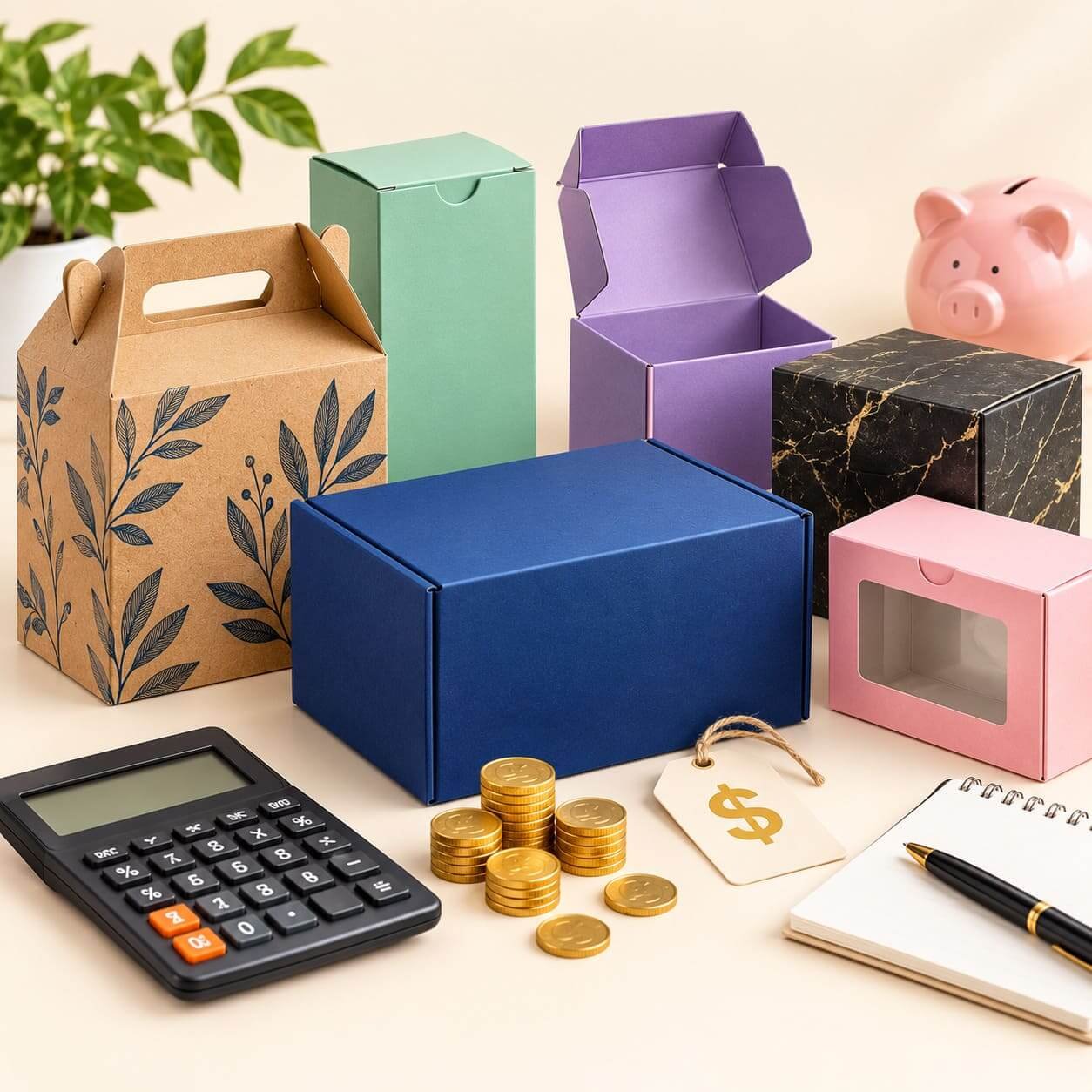
If you’re planning to order packaging for your business, you may be wondering, how much does a custom box cost?
There isn’t a fixed price for every box. A small product carton, a shipping mailer and a luxury rigid box can all have very different prices. The final cost usually comes down to the size, material, printing, finishing and number of boxes you order.
For some simple packaging made in larger quantities, the unit price can start at around $0.07 per box. Smaller runs and more complicated designs tend to cost more. In the UK, a standard digitally printed custom box can often cost somewhere between £0.80 and £3.50 per unit, depending on what you need.
So, what exactly makes the price go up or down?
What affects the cost of a custom box?
Box size
The size of your packaging is one of the first things a supplier will look at.
A bigger box uses more board and generally costs more to manufacture. There’s also little point in paying for a large empty space around a small product.
A properly sized box can help you save on material and, in some cases, reduce your shipping costs too.
Material
The material you choose has a big effect on the finished price.
Folding boxboard is often suitable for retail packaging, while corrugated board is commonly used for products that need more protection during shipping. Rigid board is a popular choice for gift and premium packaging.
You don’t always need the heaviest board. The sensible approach is to choose a material that can handle your product without adding unnecessary cost.
Printing
Then there’s the artwork.
A box with a simple logo and a small amount of printing will generally cost less than one covered in detailed full-colour artwork. Printing on both sides of the packaging can increase the price as well.
Digital printing can be a good option for smaller orders because it allows you to produce branded packaging without having to place a huge order.
Finishing
Finishing can give a box a completely different look and feel.
Depending on the design, you might choose:
- Matt or gloss lamination
- Foil stamping
- Embossing
- Debossing
- Spot UV
- Special coatings
These extras can make packaging feel more premium, but they also add to the production cost. If you’re working with a tight budget, a simple design with good-quality printing may be all you need.
Quantity
Quantity is another big one.
Ordering 50 or 100 boxes usually means paying more per unit than ordering 500 or 1,000. The reason is fairly straightforward: production and setup costs are spread across the total number of boxes.
That’s why certain simple, high-volume packaging orders can reach prices around $0.07 per unit.
Typical custom box prices in the UK
If you’re putting together a packaging budget, these figures can give you a rough starting point:
| Packaging type | 50–100 units | 250–500 units | 1,000+ units |
| Printed mailer boxes | £1.50–£3.50 | £0.90–£2.00 | £0.60–£1.20 |
| Tuck-end boxes | £0.80–£2.00 | £0.50–£1.20 | £0.30–£0.80 |
| Printed paper bags | £1.00–£2.50 | £0.70–£1.50 | £0.45–£0.90 |
| Rigid gift boxes | £3.00–£8.00 | £2.00–£5.00 | £1.50–£3.50 |
| Printed roll labels | £0.10–£0.40 | £0.06–£0.20 | £0.03–£0.10 |
Keep in mind that these are rough guide prices. Your actual quote could be different based on the box dimensions, material, printing, finishing and delivery.
Does ordering more make custom boxes cheaper?
Usually, it does.
A supplier has certain costs involved in preparing and producing an order. Those costs don’t change much whether you order 50 boxes or 500.
When you order more, the same production costs are spread over a larger number of units. As a result, your price per box can fall.
For example, you might pay considerably more per box for 100 units than you would for 500 units.
But don’t automatically order thousands just to get the lowest unit price. If you’re still figuring out how much stock you’ll sell, unused packaging can take up storage space and tie up your money.
Digital printing or litho printing?
The printing method can also affect your packaging budget.
Digital printing is often suitable for smaller orders. It’s flexible and works well if you’re launching a new product, testing packaging or simply don’t need thousands of boxes.
Lithographic printing usually has more setup involved, but it can make sense for larger production runs where the lower unit cost offsets the initial setup.
If you’re unsure, ask your packaging supplier to compare both options for your required quantity. A side-by-side quotation will give you a much clearer picture.
How can you reduce the cost?
There’s no need to strip your packaging down to the bare minimum. A few smart choices can make a real difference.
Choose the right size
Measure your product carefully and avoid unnecessary empty space. A smaller, well-fitted box can use less material and may also be easier and cheaper to ship.
Keep the structure simple
Complex packaging usually takes more work to manufacture. If a standard tuck-end or mailer box does the job, keeping things simple can help keep the price down.
Don’t add every possible finish
Foil, embossing and other effects can look fantastic, but they aren’t essential for every product. Pick the finishes that genuinely improve your packaging.
Compare different quantities
Ask your supplier for prices at several levels, such as 100, 250, 500 and 1,000 units.
Sometimes increasing the quantity slightly can make a surprisingly big difference to the unit price.
Ask about alternative materials
If your quote is higher than expected, ask whether a different board grade or material would work. You may be able to get the same level of protection without paying for an unnecessarily heavy specification.
What information is needed for a quote?
Getting a custom packaging quote is much easier when you have the basic details ready.
A supplier will usually need:
- Box length, width and height
- Required quantity
- Box style
- Material preference
- Artwork or design
- Print requirements
- Finishing requirements
- Delivery location
There’s a big difference between saying, “I need 500 boxes,” and providing the complete specification.
The more details you provide, the less likely you are to receive a vague estimate.
Is custom packaging expensive?
It can be, but it doesn’t have to be.
Basic packaging produced in larger quantities can have a surprisingly low unit price. In some cases, simple high-volume boxes can start around $0.07 each.
Premium packaging is another story. Rigid boxes, heavier materials, detailed printing and multiple finishing processes can push the price into several pounds per unit.
The important thing is to choose packaging that makes sense for your product.
A small retail item may only need a simple folding carton. A luxury gift product might benefit from a rigid box with a premium finish. Meanwhile, an online retailer may care more about strong shipping packaging and efficient dimensions.
How much should you budget for a custom box?
For certain simple, high-volume orders, $0.07 per box can be a possible starting point.
For many standard UK packaging requirements, you might budget around £0.80 to £2.00 per box for straightforward custom printed packaging. Larger mailer boxes and premium rigid packaging can cost considerably more.
The exact figure depends on your specification, so it’s important to compare quotations on a like-for-like basis.
Check the size, quantity, material, print, finishing and delivery before deciding which quote works out cheaper.
Final thoughts
So, how much does a custom box cost?
For certain basic, high-volume orders, the price can start around $0.07 per unit. For smaller UK orders or more premium packaging, you could be looking at anything from around £0.80 to several pounds per box.
There isn’t a magic number that applies to every business.
Get the box size right, choose a suitable material, keep unnecessary extras under control and compare a few different quantities. Those simple steps can help you get packaging that looks professional without spending more than you need to. Read more: greeting card dimensions