
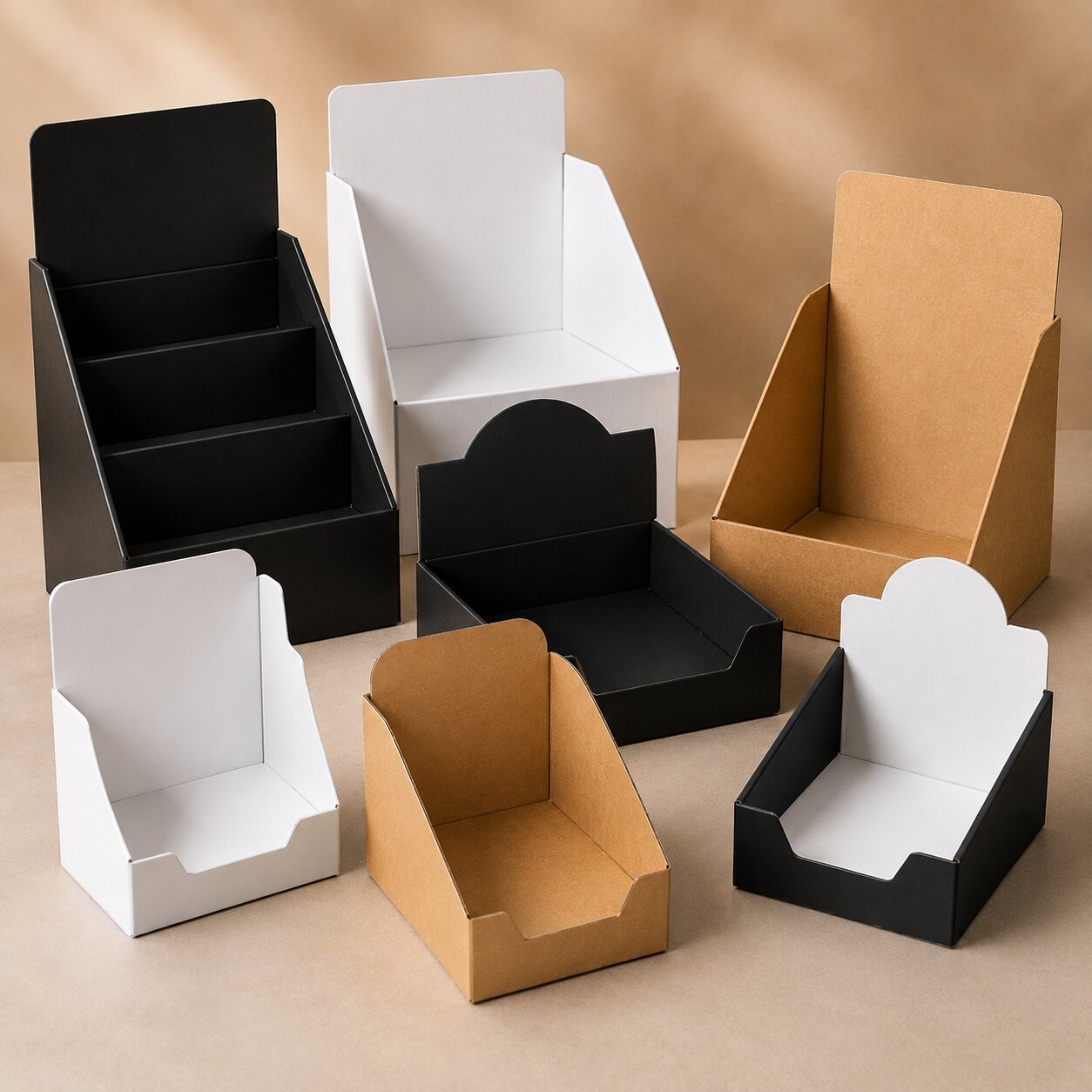
Normally, the size of your products, the available shelf or counter space, and how you plan to rotate stock during promotions or seasonal sales define the number of custom display boxes that your business will require. Across the UK, retailers work with a myriad of variants; from small countertop display boxes for cosmetics to large floor standing units for supermarkets. The choice can be directly related to your product category and the shopping habits of your customers. Material type, box dimensions, and printing finish all play a role in how many units fit into a single carton, which in turn affects how many boxes you should order at once. This is very pertinent to store owners and brand keepers in London, Manchester, and Birmingham who try to balance shelf presentation with storage costs. If you are exploring options, The Printed Packaging offers custom display boxes for your product range to help you get the sizing and quantity right from the start.
What Are Custom Display Boxes and Why Do Businesses Use Them
Custom display boxes are a type of special package that presents the product right on a shelf, counter, or floor stand, unifying protective packaging with an advertising function. They are designed with the protective impact of ordinary shipping cartons but with much more consideration for branding impact, mostly open-face designs, printed graphics, and structural cuts to expose the product and allow easy grasping. Because they are used as both storage and marketing tools by businesses, the separate signage or shelf talker need is less. In the UK, retailers depend on this packaging style to help push items in the crowded aisles especially in the cosmetics, confectionery, and electronics accessories categories where shelf appeal drives impulse purchases.
The appeal comes down to convenience for staff. A well-designed display box can be unpacked and placed straight onto a shelf without any additional handling— saving time during busy retail periods. Small businesses, for this reason, now buy custom display boxes online, rather than generic ones that don’t match their brand identity.
Types of Custom Display Boxes
There are several common categories worth understanding before placing an order. Counter display boxes, sometimes called PDQ trays, sit near the till and are ideal for small, high-margin items like sweets, batteries, or beauty samples. Floor standing display units are larger and typically used in supermarkets or pharmacies to showcase bulkier products, or seasonal promotions. Then there are pillow-style and dump bin displays, which are less structured but work well for loose or irregularly shaped items such as snacks or toys.
This category can be made with different material types, for example, corrugated cardboard to make sturdier floor units and lightweight paperboard to make smaller counter displays. Material choice often comes down to how long you need the display to last and how much weight it needs to support — which ties directly into durability and shelf life considerations. Many UK suppliers also offer eco-friendly options made from recycled board. This has quite gained the popularity of most brands since it helps in reducing the environmental footprint while still allowing for a premium look.
Sizes, Quantities, and Variations Explained
The sizing is where most of the confusion comes in and for good reason because there is no single standard size for custom display boxes as there might be for shipping cartons. A small counter unit might measure around 20cm by 15cm by 10cm; a floor-standing display could easily reach 100cm or more in height. Quantities per shipment vary as well since a supplier might pack 50 small units into a single master carton but only 10 to 15 larger floor units into the same space.
Side-by-side comparison of dimensions would clarify what suits your needs. A retailer who sells small cosmetic items may need only a shallow depth in the boxes to keep the products visible. On the other hand, a business that sells boxed electronics may need compartments of greater depth with dividers to prevent the items from shifting inside during transportation. To get it right the first time would save on reprints and reduce waste — that’s why most buyers ask for samples or a detailed quote before they commit to a full production run.
UK Packaging Regulations and Industry Standards
Packaging sold or used within the UK must generally be compliant with recycle and environmental regulations — especially since the recent EPR (Extended Producer Responsibility) rules have tightened the noose on brand responsibility for the packaging they introduce to the market. This makes it a point for businesses ordering custom display boxes to consider material sourcing, recyclability labelling, and any restrictions on non-recyclable coatings or laminates. For food-related display packaging, there are additional requirements on safe materials that come into contact with consumables, so you should ask your packaging supplier about board and inks meeting the current UK food-contact safety standards where relevant.
Many UK retailers consider FSC-certified board as the baseline standard, as a signal to sourcing responsible earth-friendly customers above the minimum legal requirement. It can work with a manufacturer who knows these standards instead of an overseas supplier who does not know the requirements of the UK to make the process of approval much smoother.
How Display Boxes Impact Branding and Customer Experience
The way a product is displayed often shapes the quality perception of a customer even before picking it up. A nicely printed, firm display box with a clean custom design signals professionalism; a flimsy or badly printed one can undercut even a great product. For businesses throughout the UK that are trying to build brand recognition in a competitive retail environment, display packaging is often the first physical point of contact that a customer has with the brand, making the branding impact of these boxes larger than many business owners initially expect.
Apart from the look of things, display boxes also define the actual shopping experience. Clear labelling, easy-to-read pricing sections, and intuitive product placement within the box all minimize friction at the point of sale. The supplier of this packaging has a say in this because good print quality and structural reliability on repeat orders ensure that the brand experience remains uniform, whether a customer comes across the display in a small independent shop or a larger high street chain.
Technical Specifications and Material Choices
First-time buyers often underestimate the importance of such technical details. Board thickness is measured in GSM (grams per square metre) or micron for finer materials. These determine the weight a display can carry without sagging or collapsing. A typical counter display would use board in the 300 to 400 GSM range; heavier floor-standing units often require corrugated fluting for added rigidity. Printing finish comes as a second consideration-the range of options available includes matte and gloss laminates, and spot UV coating for highlighting logos or key product information.
Measurements should always be taken with a small tolerance margin, as the printed board can shift slightly during die-cutting and assembly. Most good manufacturers will automatically incorporate this into their production processes; however, it is always good to check the measurements with them before finalizing a bulk order. This is more important if the display is to fit into a specific shelf space or an existing store fixture.
Advantages of Buying Custom Display Boxes in Bulk
Ordering in bulk makes clear financial and logistical sense — so most established retailers order custom display boxes in bulk, not small orders. Typically, the wholesale packaging price per unit drops quite significantly once order volumes increase — because the setup costs for printing plates and die-cutting tools are spread over a larger batch. That makes bulk ordering one of the most affordable packaging strategies — especially for seasonal campaigns where the same display design will be used across multiple store locations.
Ordering has, in fact, become easier with most reputable suppliers having a user-friendly online system to get a quote for custom display boxes, with most even giving digital proofs before manufacturing. Most businesses, while seeking the best supplier for their display packaging, want a manufacturer in the UK who can offer not only competitive wholesale rates but quick and reliable turnaround times as well because late deliveries can cost them heavily in terms of associated product launches or promotional calendars. Bulk purchasing reduces the risk of getting caught short halfway through a campaign, which often happens when the initial order size does not accurately reflect the true level of demand for the product.
Conclusion
To put it in perspective, the quantity of custom display boxes required is determined by the size of the product, the shelf space, and the approach to stock rotation, and hence there is no fixed common answer across the industry. This should help businesses in the UK to plan their next packaging order more effectively, whether it is a small counter display or full retail rollout. When you are happy with the quote, The Printed Packaging – UK will provide you with personalized quotes and some extra discounts on bulk orders, so contact them today to place your order for custom display boxes and find out how reasonably priced a professional packaging solution can be. Read more: Bottle Packaging
Frequently Asked Questions
How many display boxes fit in a standard shipping carton?
Are custom display boxes recyclable in the UK?
Where can I buy custom display boxes online near me?
What's the difference between a display box and a shipper box?
How much does it cost to order custom display boxes in bulk?
Can small businesses order custom display boxes, or is bulk ordering only for large retailers?
What materials are best for display packaging?